
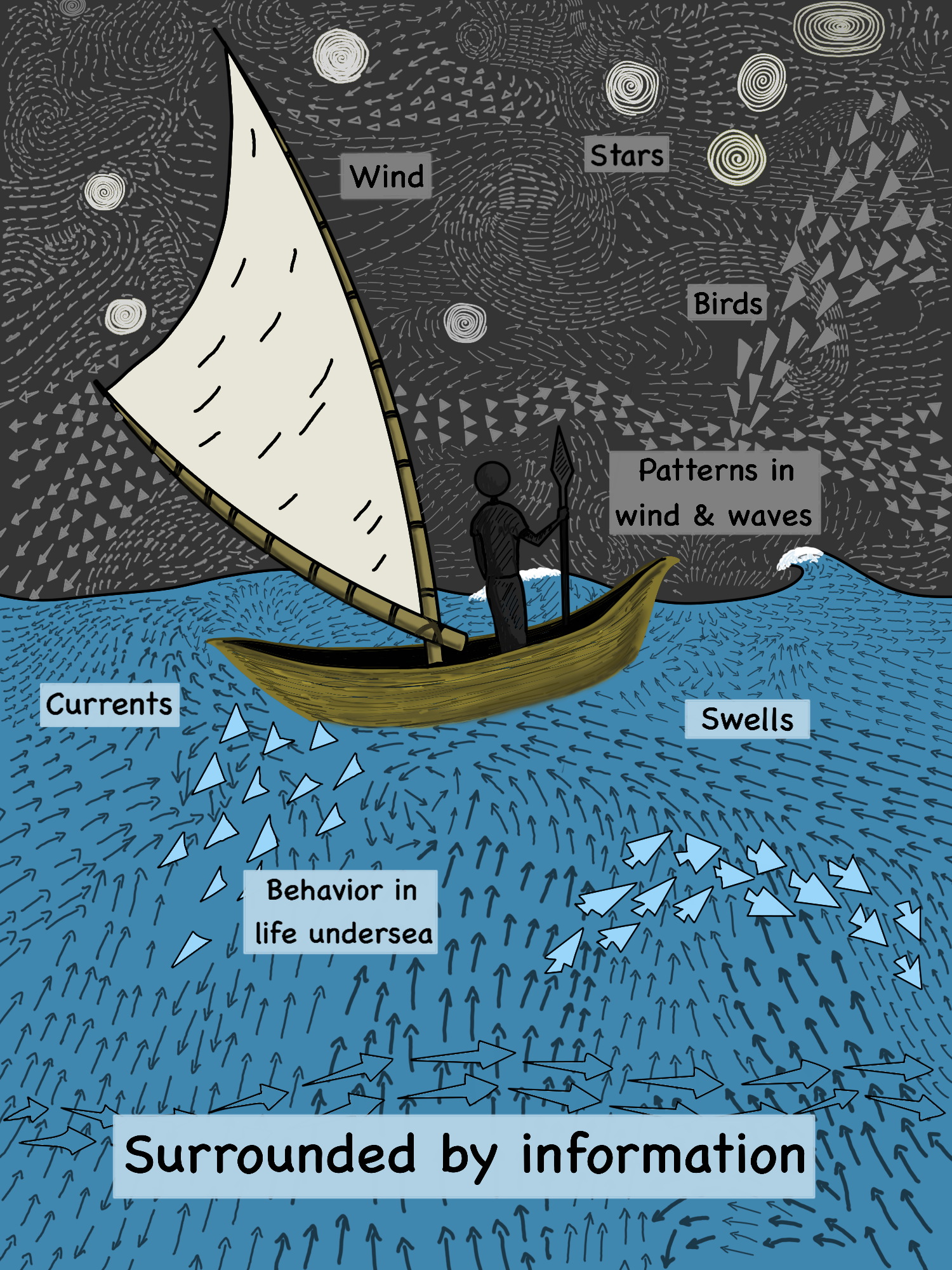
We swim in a sea of information. Your brain… mine too, I hope, receives a billion bits of information… EVERY SECOND. What’s weird about that is we are only consciously aware of maybe ten bits of that billion.
Another way of saying that… 99.9999999999% of the information we receive is filtered out.
What gets past the filter… and why?
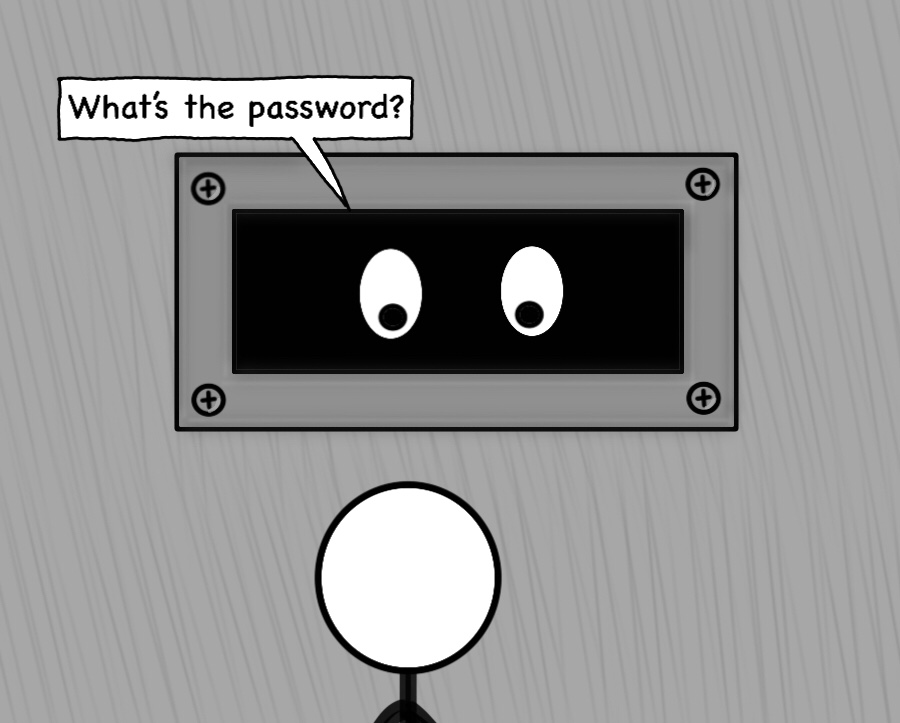
Nobody knows. The best theory is anything that has to do with survival gets priority. Whatever bandwidth left over goes to fine tuning what we’re focused on. Work. Play. Sex. Making ourselves crazy. Whatever. Probably not social media and tv.
In this context, we can think of learning as the process of tuning the filter. Not deciding… but discovering which, of the billion bits bombarding you, matters. A progressive education of your attention. The great Carl Woods calls it “wayfinding”.
Those who play tennis matches want to know the match space. You can accurately think of a tennis match as super high speed, mobile, chess. Every ball sent your way is a problem that needs to be identified and solved… in milliseconds. Your solution demands more than awareness of what’s possible from where. You also have to be able to run your ass over… and execute it, in less than the time it takes to take a breath. And you’ve gotta do that over and over and over… hundreds of times. Compounding the complexity… no problem repeats. Ergo, no solution can be memorized. Meaning you’ve gotta invent every single one of those solutions in real time.
Pretty amazing when you think about it like that. Explains tennis’s steep learning curve.
What’s the best way learn such a thing? Here’s what the research tells us…
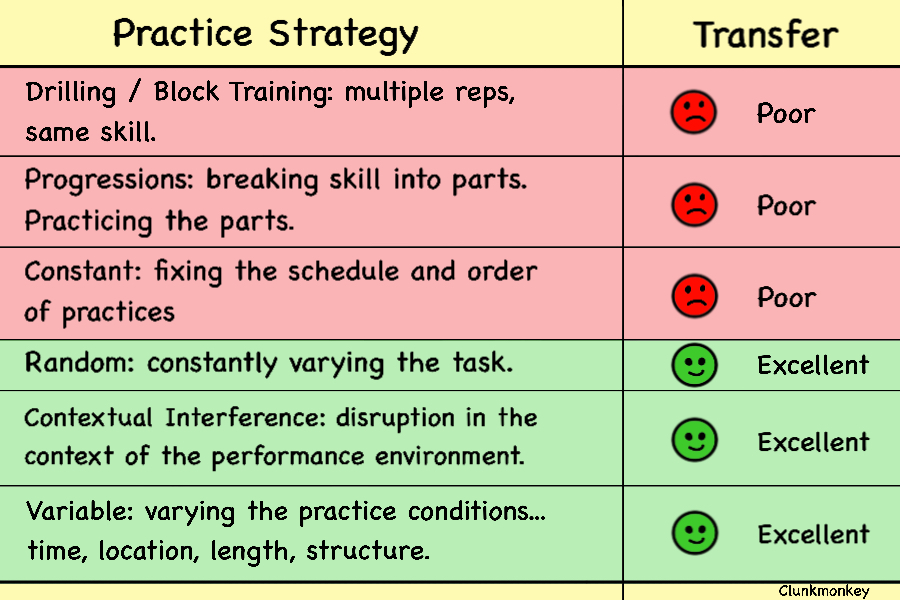
The Ugly: this stuff is a total waste of time. (Almost always)
Hitting against a wall. Ball machines. Hitting serves from baskets. Hand tossed balls. Coach fed drills.
I know, you’re not super happy with this list. Hitting against a wall is a creation backstory for a lot of legends. Sorry, don’t go after the messenger. The research is clear. Unopposed (no opponent) training is virtually worthless. The transfer, from practice to match play, is poor.
That does make some sense though… right? This kind of training lacks the dynamic, perceptual and decision making elements inherent in match play.
Some silver lining… you’ll notice I hedged. I said it’s “almost always” a waste of time… that the training is virtually worthless. There are limited instances where unopposed training can be somewhat useful. I’ll loop back to that at the end.
The Bad: this stuff does not deliver as advertised, but there may be some marginal, unintended benefits, so we can’t say it’s a waste of time. However, these are definitely not the best use of your time.
Traditional tennis lessons. Clinics. Part to whole progressions. Traditional tennis drills… crosscourts, down the lines. Crosscourt, down the lines. Blocked training… any exercise where you prescriptively repeat a skill, has poor transfer.
Ok. Slaughtered a few scared cows. Definitely stepping on some toes here. C’mon, be honest… you kinda already knew this. You can hit a solid kick serve, into an undefended square, when your pro’s there telling you what to do and how to do it. 4-5, 30-40 down, against an opponent… you can barely get the ball over the net.
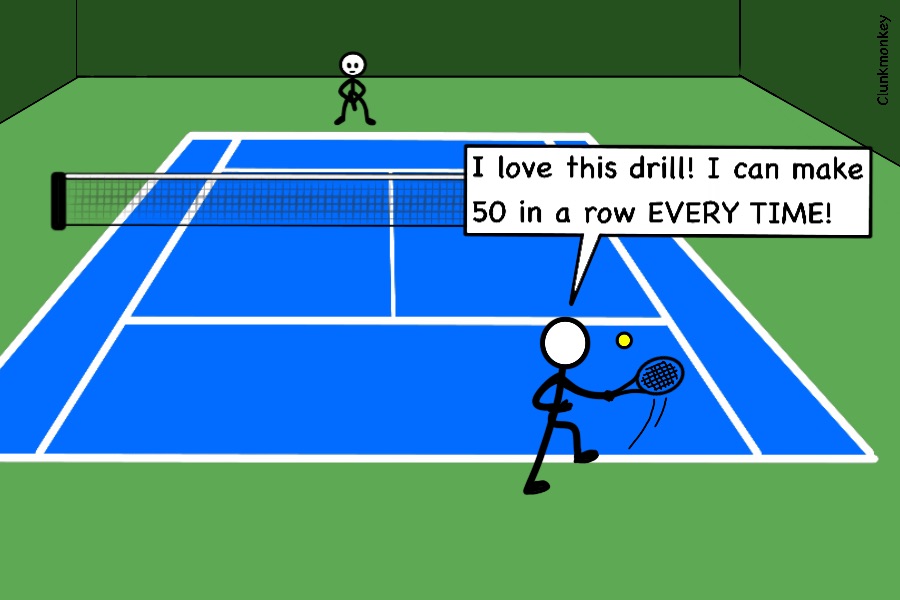
When drilling, you can keep a crosscourt rally going for thirty, forty, fifty balls.
You can’t hit three in a row in a match.
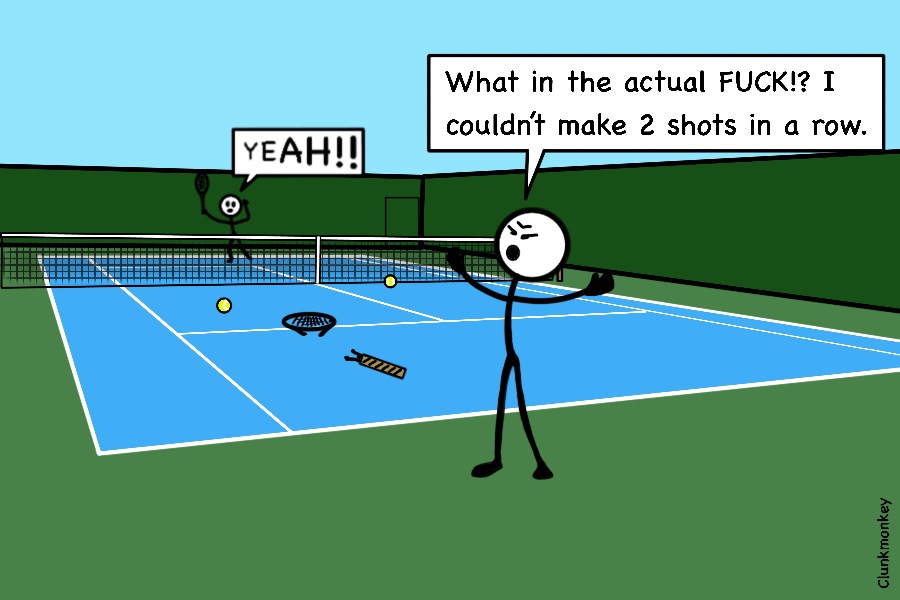
What’s going on? Matches are a totally distinct environment. They’re highly dynamic, random, and variable. Drills and lessons are not. Meaning they do not train the key skills of match play.
Yes, after ten minutes of hitting only forehands it feels like your forehand is better. And this is a reason instructors love drills. They can prescribe a move… or a fix, whatever, you hit for ten minutes.. voila. It seems like it works! You hand over the hundred bucks for your lesson… and promptly go out and lose to your rival… in all the same ways. Then what? Another lesson? Or maybe… more drilling?
Study after study after study has concluded that variability results in better skill retention than blocked training. “Yeah, ok, but… those drills help my confidence!” I hear that one a lot. I gotta ask, what is wrong with your confidence that doing drills, that don’t work, can fix?
By the way, confidence isn’t knowing you will… or believing you can do “it”. Confidence is being cool with yourself… whatever happens.
The belief that we need to be taught and drilled comes from the myth of fundamentals… the old “textbook technique”.
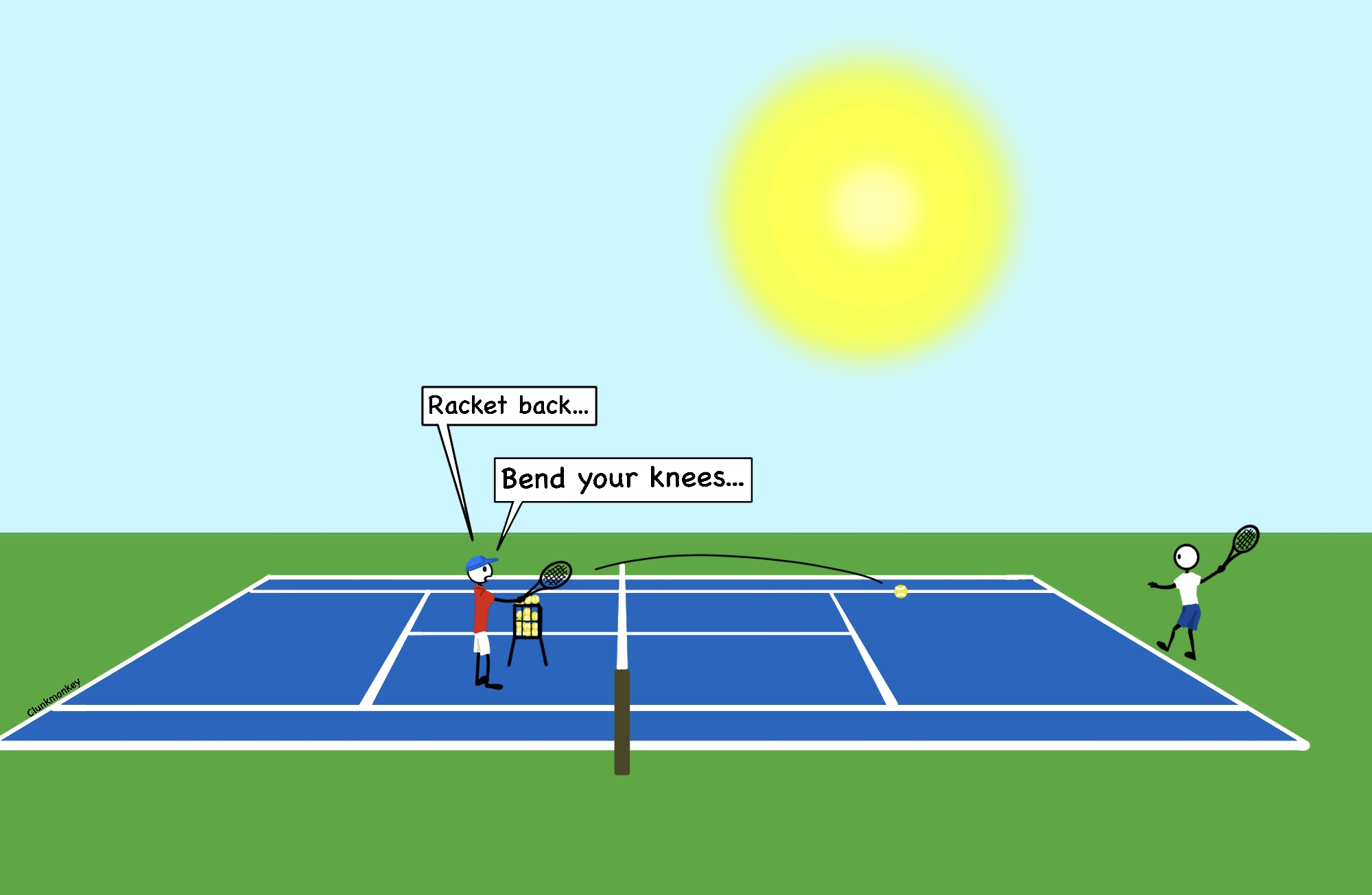
There is no such thing as textbook technique. Fundamentals do not exist. Again, the research has weighed in. Multiple movement solutions can achieve the same outcome.
After four weeks of twice weekly play, new learners, who are not taught technique put the ball in play as consistently as new learners whose technique has been explicitly prescribed to them.
The technique, that matters, is emergent, as in doesn’t need to be taught.
You may say to yourself… “self, if the untaught and taught all have roughly the same abilities, then what difference does it make if they’re told what to do?”
The answer to your question: in the weeks, months, and years that follow, those who are not explicitly instructed exhibit increased range of solutions as the task becomes more complex.
I know, that’s a lot of jargon. In plain English… in matches, the uninstructed put more balls in play, in more ways, than the instructed.
Reminder: I’m talking about the tennis learning space of competitive match play. Not what’s fun, or good for the pocketbook of pros or clubs, or what some say is “good for the game”. Those can be separate things.
The Good: this works!
Playing the game. It’s so simple… and obvious, a child can figure it out. They usually do. But… damn, you can’t make much money off of people figuring shit out on their own.
Don’t worry colleague, I’ve got you. If you know the game environment, you can design non-linear, variable practices for it, for a few bucks. Here’s an example:
Lets say a coach wants to work on adaptability… the ability to respond to changing input (strategy, conditions, condition…), which, by the way, would be a good thing to work on, because it is a huge part of match play that is almost never directly addressed. Any coach who wants to work on this knows their stuff.
Our coach creates a game where the players play regular games… you know, 15-30-40… alternating serves, like a set. At random intervals the players have a change forced upon them. Say… first, they have to play with an unfamiliar racket, and then switch back, then switch to green or red dot or foam balls, and back… then maybe it’s an unfamiliar racket and a weird ball, next maybe they get only five seconds in between points… etc. The key is that they are forced to deal with alterations that change the information that’s useful to the player.
Coach tells the players the point of the game… then turns ‘em loose. If it’s working… the coach grabs a lawn chair, opens a beer… (ok, I’m kidding… about the lawn chair) If it’s not working… if the players are too confused, or too frustrated, the coach tweaks the exercise until it works.
The coach does not instruct. He allows the players explore the space and tune their filters… to wayfind.
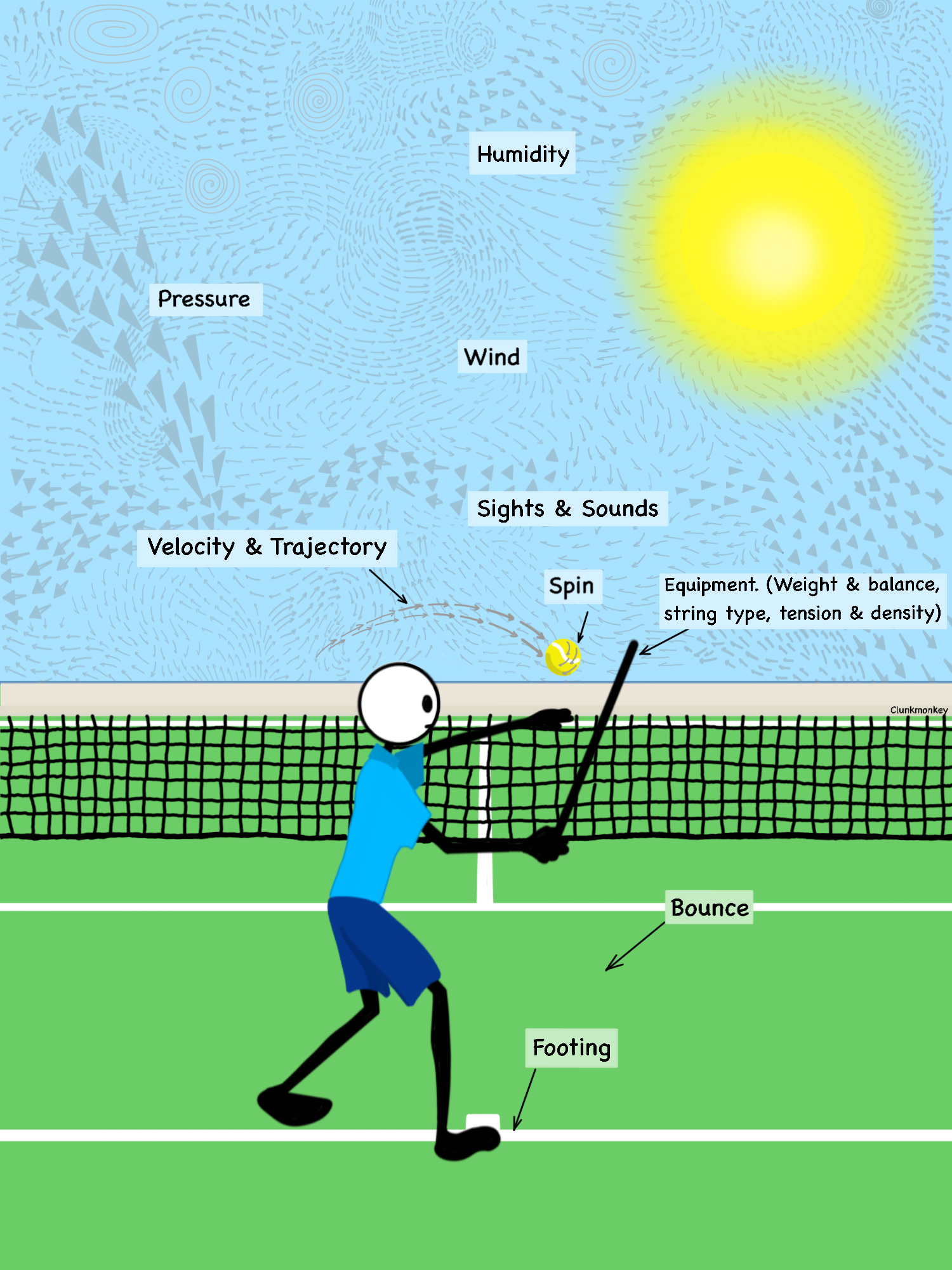
It’s dynamic, random, variable, perceptual, opposed, information rich, and retains the decision making context of a match environment… with zero prescriptions. The ideal learning environment. Unsurprisingly, the transfer from exercises like this into match play are excellent.
It’s a tectonically different view of instruction. One that is not supported by any of the major coaching accreditation agencies.
There is an epidemic failure in tennis coaching to understand what is really going on. The thinking is medieval. Myths and superstitions are given fact status. Dumb questions are asked… and answered. Students are misinstructed by their teachers.
It doesn’t have to continue. The answers surround you. They always have. You only have to recalibrate your filter… and let them in.
Oh yeah, I almost forgot to get back to unopposed practice. One example of a situation where unopposed practice seems to work: you want to experiment / invent a solution (shot) you’ve never tried before. In this case hitting some balls fed to you or a few minutes on a ball machine isn’t the worst idea you’ve ever had.
Here’s a guide for future reference:
PS. If you liked this post 4 out of 5 dentists predict you’ll love my book: The Art of Holding Serve. Get your copy here!